‘To continue painting’: : James Bishop and New York
-
Overview

Timothy Taylor is pleased to present ‘To continue painting’: James Bishop and New York, an exhibition of paintings by James Bishop (1927–2021), curated by art historian Molly Warnock. On view in New York from 15 January through 28 February, the exhibition brings together eight paintings and eleven works on paper spanning ca. 1960 to 1987, a period of notable productivity, invention, and recognition for the artist. Presented only blocks from Bishop’s former Lispenard Street studio, the exhibition’s title is drawn from a grant application the artist submitted to the National Endowment of the Arts in 1973, in which he requested support, simply, “to continue painting.”
This is the artist’s first solo presentation in New York in more than a decade. In conjunction with the exhibition, Warnock will be in conversation at the gallery with painters Amy Sillman and David Reed on 28 January.
Bishop carved his own path among the American and European postwar movements with subtle abstractions that privilege expression as much as process and materiality. The Missouri-born painter, who moved to Paris in 1958 and then spent most of his life in Blévy, France, considered himself to be “an Abstract Expressionist of the quieter branch.” The earliest works on canvas in this exhibition, Untitled (1961–62) and Hours (1963), reveal the artist’s relationship to developments in painting in the States. Though his work resonates with aspects of Colour Field painting, unlike those contemporaries, he worked on primed canvas such that colour didn’t soak into the fabric; his pigment remained explicitly on the surface as a skin, marked by evidence of the artist’s hand and brush. These traces likewise distance the artist from the Minimalists, though there is a clear reductivism in his approach. Hours, in particular, is a pivotal work that foregrounds the emergent method and compositional interests that would characterise Bishop’s output moving forward.
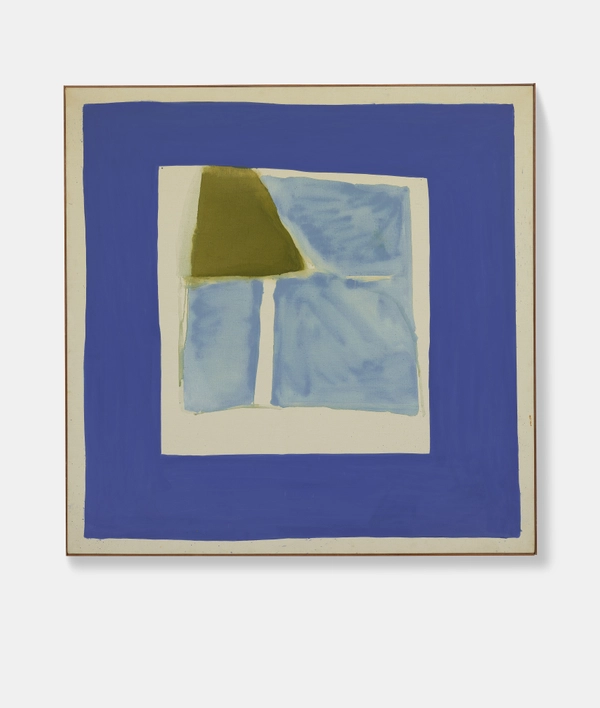
Bishop’s process involved tilting a stretched and pencilled canvas, on the studio floor, to distribute diluted oil paint, curbing the flows of pigment such that they would be contained within the limits of his pre-sketched geometries. The process invited chance while also asserting control and emphasised the conditions of the support—its dimensions, texture, and flatness. In Hours, this procedure resulted in a central passage of blue and green that approximates a gridded square. Framing this form is an uneven band of rich cerulean that echoes the proportions of the canvas.
These elements recur across the six larger paintings on view, which assume the human-scaled 77 x 77-inch square format the artist would adopt as his standard between 1967 and 1986. Fields of earthy white, umber, olive, and grey hues are intersected by elusive, modulating lines. Recalling doors, ladders, and scaffolding (the poet John Ashbery described Bishop’s paintings as “half architecture, half air”), these architectonic divisions of the pictorial space are enlivened by Bishop’s paint handling. Slight irregularities and asymmetries return the viewer to the inconstant nature of the painting body. Warnock, who has published extensively on the artist, writes, “It is through such displacements that the distinctive expressiveness of Bishop’s paintings emerges.”
Iteration and variation were also central themes for the artist, as evidenced by the eight exhibited works on paper, which occupy more intimate formats. Even as he worked on paper (and as acrylics became popular among his peers), Bishop only used oil paints, valuing their translucency and richness. Many of these works play with the same geometric compositional elements, subtly ushering them between background and foreground, veiling or exposing them. In each version, Bishop’s rearrangements generate surprising tensions between whole and part. Warnock, again, keenly identifies this quality: “Bishop’s repetition is less a matter of one thing after another than of one thing emerging where it touches another, and so already bound up with that other: It is more intimate than seriality.”
Luminous and delicate, these works offer a nuanced insight into a painter who quietly, diligently pursued a practise that explored, through repetition and variation, dynamics of ambiguity and incongruity within discrete structures.
-
Works
-
James BishopHours1963Oil on canvas50 x 51 ½ in. (127 x 130.8 cm)
-
James BishopLimited1971Oil on canvas77 x 77 in. (195.6 x 195.6 cm)
-
James BishopOld Holland1979Oil on canvas76 ½ x 76 ½ in. (194.3 x 194.3 cm)
-
James BishopOil on paper11 ⅛ x 11 ⅛ in. (28.3 x 28.3 cm)
Framed: 16 3⁄4 x 16 3⁄4 in. (42.5 x 42.5 cm) -
James BishopUntitledca. 1960–62Oil on paper19 ⅞ x 25 ¾ in. (50.5 x 65.4 cm)
Framed: 25 5⁄8 x 31 1⁄2 (65.1 x 80.0 cm) -
James BishopOil on paper22 ⅛ x 22 ⅛ in. (56.2 x 56.2 cm)
Framed: 27 7⁄8 x 27 7⁄8 in. (70.9 x 70.9 cm)
-
-
-
Installation Shots
-
-
Press
-
James Bishop
Jason Sopa, Artforum, 1 April 2026 -

JAMES BISHOP, AN AMERICAN HERMIT IN BLĒVY
Gwenaël Kerlidou, Tussle Magazine, 5 February 2026 -

‘To continue painting’: James Bishop and New York
Patricia L Lewy, The Broolyn Rail, 4 February 2026 -

Fluency Without Progress
Quiet Modernism , 3 February 2026
-
-
Event
-
To learn about our presentation, please provide your contact information


